Quiet Time
We are all fanatics when we are lost in our minds.

This winter, at my wife’s prompting, we made an unexpected decision to return to snowshoeing for winter hikes. I write unexpectedly because around 2007, we, like many others, embraced Kahtoola’s revolutionary MICROspikes for winter hiking. MICROspikes (don’t confuse these with the far inferior products made by other companies) made winter hiking much faster. They weigh a fraction of snowshoes and are often all that is necessary after a trail has been packed down.
On Sunday, while snowshoeing in the peaks above Lake Winnipesaukee, we stopped at a viewpoint and chatted with a couple hiking in MICROspikes. Seeing our snowshoes, the woman commented, “Those are too heavy, I don’t like hiking in them.”
I began to pitch snowshoes. I explained that using snowshoes is intentional—it helps us slow down mentally. Instead of focusing on how far or fast we go, we pay more attention to the experience itself. Even if we don’t cover as much ground, we’re more present in the moment. Plus, in snowshoes, we pack down the trails, which helps hikers who come after us.
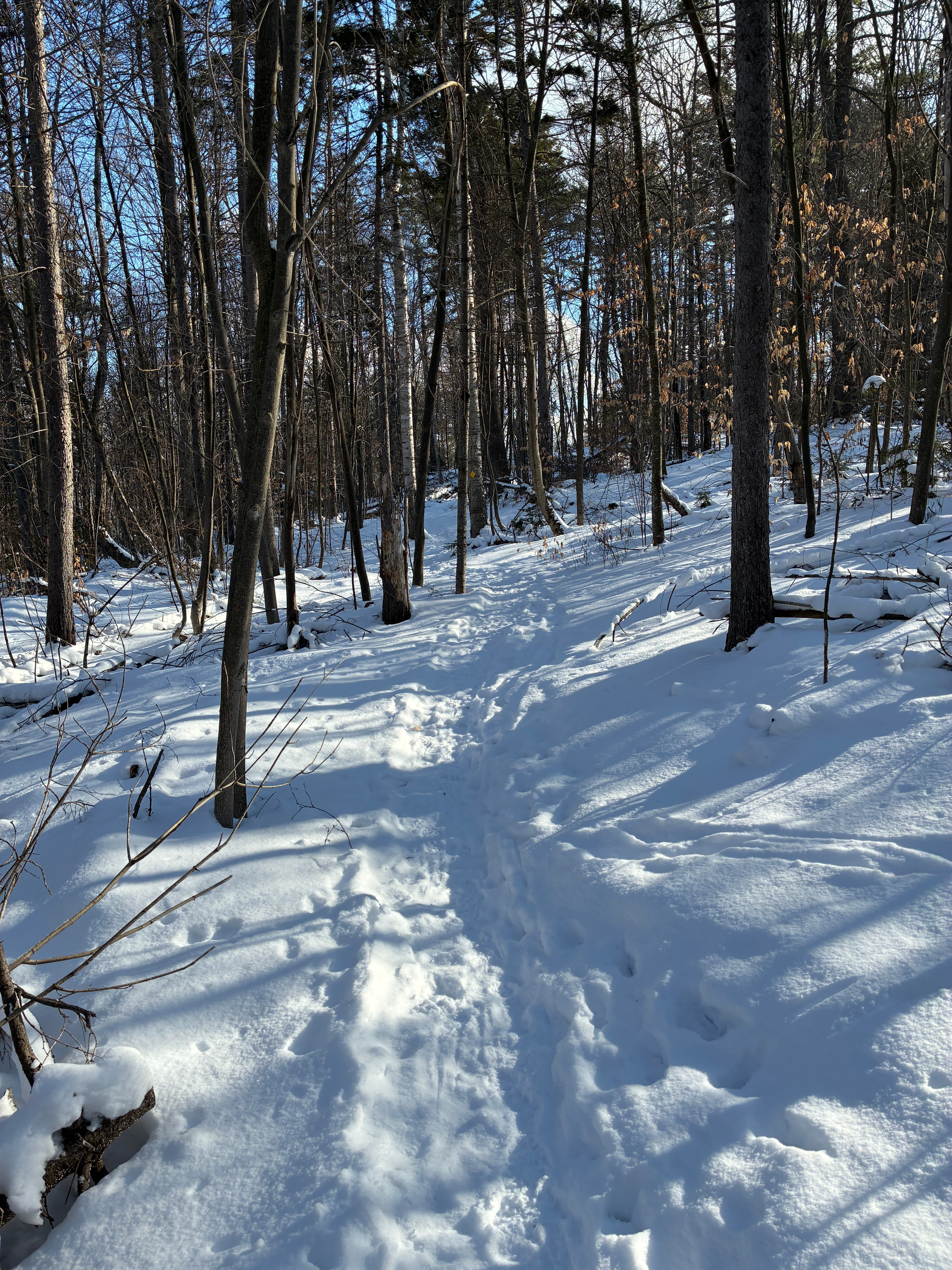
I’m not sure if she was getting my point. She didn’t stick around for the full lecture, but if she had, I would have explained that when I stop thinking about what’s next and focus on the present, even tasks that might be viewed as tedious—like carrying the extra weight of snowshoes—become enjoyable. Being present is the secret sauce that makes both ordinary and extraordinary experiences more meaningful.
Now, of course, a hiking experience with presence can be had on MICROspikes, but for me, focusing on speed makes hiking more transactional.
“Forever – is composed of Nows,” wrote Emily Dickinson.
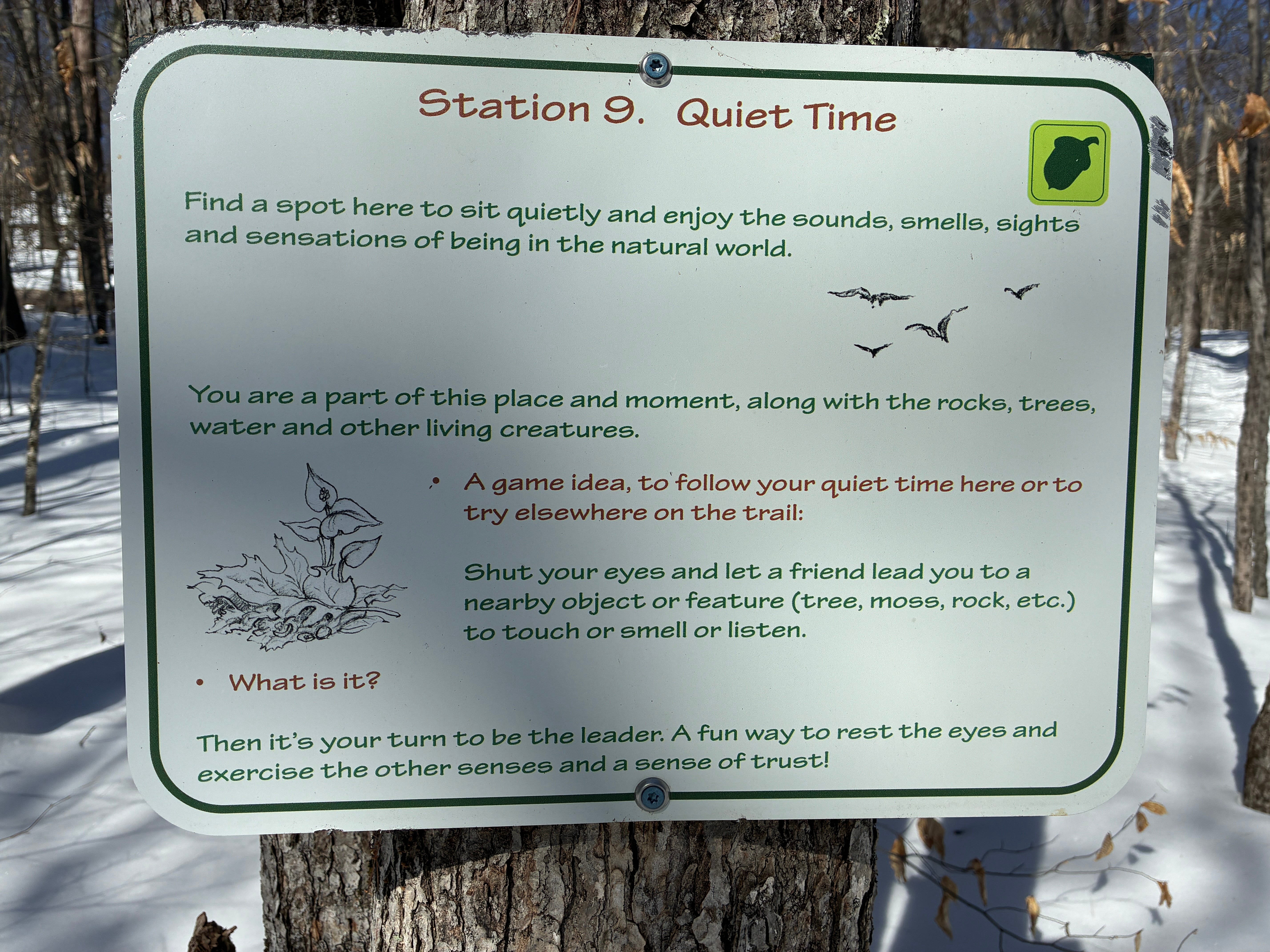
An interpretive sign lower on the trail reminded us, “we are a part of this place and moment.”
We forget. What’s next, our mind chatters. Too cold, too hungry, too many things to do. What’s next? We can be lost in the forest even if we know exactly where we are.
The old-growth forests in the American Northwest contain some of the tallest trees in the United States. The late poet and professor David Wagoner, in his poem “Lost” answers the metaphorical question, “What do you do when you are lost in the forest?”
Stand still. The trees ahead and bushes beside you
Are not lost. Wherever you are is called Here,
And you must treat it as a powerful stranger,
Must ask permission to know it and be known.
When we are lost in our minds, doesn’t the same answer apply? Stand still.
The poem entirely reframes “being lost.” The trees and bushes are not lost; only the hiker is disoriented when they’ve stopped attending to where they actually are. “Wherever you are is called Here” is the poem’s central philosophical insight—the problem isn’t that we’re in the wrong place, but that we’re refusing to fully inhabit our present location. When the mind is noisy with panic or problem-solving, we treat our surroundings as obstacles rather than as “a powerful stranger” worthy of respect and attention.
Wagoner continues,
The forest breathes. Listen. It answers,
I have made this place around you,
If you leave it you may come back again, saying Here.
No two trees are the same to Raven.
No two branches are the same to Wren.
If what a tree or a bush does is lost on you,
You are surely lost. Stand still. The forest knows
Where you are. You must let it find you.
Both Russ Harris and Wagoner remind us that when disoriented, the solution is not frantic movement but stillness. To “stand still” challenges our instinct to do something, fix the problem, or think our way out of confusion. Instead, being lost is a problem of perception and presence.
The forest knows where we are. Love knows where we are.
Notice what happens when we are not connecting with something larger: our mind’s chatter takes center stage.
When we reconnect, we are no longer lost. We feel gratitude—gratitude for the miracles of modern life, gratitude for your loved ones, and gratitude for the people known and unknown who support us.
Winston Churchill purportedly said, “A fanatic is one who can’t change his mind and won’t change the subject.” Churchill, of course, was talking about conversation with others, but in the grips of the chatter in our head, we don’t change the subject.
We are all fanatics when we are lost in our minds.
Consistent with the advice of Russ Harris, Robert Draper writes, “’silence is the answer.’ That means the answer to our mind’s fitful uprisings is to watch it’s storms and allow them to pass without interfering—not struggle against them in some heroic notion of being the one who can ‘quell the waves.’” Draper adds,
People who are adamant that their efforts to learn a better way to live must result in a peaceful mind before the noise in it subsides, miss the happy step into this mental state—that state of simply and peacefully watching the mind’s unrest each time it rises until it disappears.
Standing still doesn’t mean eliminating the noise; it means valuing something more than the noise. That valuing-created space opens an opportunity to go beyond the mind’s storms.
G.K Chesterton wrote, “A man’s soul is as full of voices as a forest; there are ten thousand tongues there, like all the tongues of the trees: fancies, follies, memories, madnesses, mysterious fears, and more mysterious hopes.”
Chesterton added, “All the settlement and sane government of life consists in coming to the conclusion that some of those voices have authority and others not.”
Isn’t that what everything depends on? Being still enough to hear the voice that speaks for Love.
Stillness arrives by grace, more by our willingness than by our efforts. Stillness and acceptance often dissolve problems that frantic action only amplifies.
It is enough, for now, to enquire within: Don’t you feel a certain tranquility when you seek to become the witness to your thoughts, rather than identifying completely with them?
As your mind stills, see if you can feel what C.S. Lewis described: “Our lifelong nostalgia, our longing to be reunited with something in the universe from which we now feel cut off, to be on the inside of some door which we have always seen from the outside, is no mere neurotic fancy, but the truest index of our real situation.”
Wagoner’s “powerful stranger” does not have to be a stranger anymore.
Thank you Barry, there is a lot of common sense that a person could hang their coat in your article.
Please keep up the good work people like yourself that share your wisdom with others are the unsung heroes of society.
Kind regards Eamonn Leonard.
Thanks for a great read Barry. Losing myself in the woods reminds me that golf season is just around the corner!